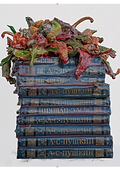
Books from the Kyiv Apartment
(45/30/20 cm, books (a Soviet collection of works by classical russian writers brought from Kyiv), dried fruits, vegetables, and plants, oil paints, polyester primer, 2024-2025)
These works are made from real books that I took from my mother’s apartment in Kyiv — collections of Russian classics that were once a typical presence on the shelves of almost every household across the former Soviet Union. They could be found in Ukraine, Russia, Kazakhstan, Belarus, Armenia, Georgia — and in many places, they are still there today.
After the beginning of Russia’s full-scale war against Ukraine, I decided to “preserve” these books by embedding them with real dried fruits and vegetables. Painted with acrylics, they mimic freshness but are in fact dead. Just as these books can no longer be opened, one cannot return to what existed before February 2022. They become objects of memory and loss, where the everyday materiality of Soviet domestic life collides with the impossibility of returning to the past.
These are authentic editions from the artist’s mother’s apartment in Kyiv — the very same “complete collections” that for decades standardized bookshelves across the former USSR. In every home they functioned as a portable canon: a single center, a single language, a single “norm” of culture that displaced local voices.
After the beginning of the full-scale war, the artist “preserved” these books by surrounding them with dried fruits. Their painted “freshness” is a fiction: just as these fruits can no longer be eaten, the books can no longer be opened — and it is impossible to return to the time before the full-scale invasion of Ukraine in 2022. This gesture is not about iconoclasm or nostalgia; it is about suspending the symbolic power of the canon. The artist transforms an instrument of ideological circulation into a mute artifact, bearing witness to the violence of assimilation and to personal loss.
The series holds a tension between preservation and interruption, memory and exposure. By translating the “universal” library into the realm of objects, the artist asserts the right to multiplicity and opacity of experience: instead of one history — many; instead of a center — a network of local, living voices.