EMBROIDERED LANDSCAPE
(object series, tulle, hand embroidery, wooden and plastic frames, 2019-2025)
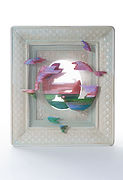
In the series Embroidered Landscape, Fedora was less interested in the ability of an object to radically change its meaning depending on the context in which it is placed, and more focused on theoretical questions regarding the historical development of its material carriers. The artist works with the concept of the pictorial "frame," seeing it as a mechanism through which humans, via art, structure reality—thereby, through their accumulated and proclaimed knowledge, establishing hierarchies of power in relation to the surrounding world. In this way, the human being places themselves above the world, which in fact means subtracting themselves from it, creating a rupture between self and environment (that is, producing the dichotomy of “nature and culture,” which, in Fedora’s view, exists nowhere except in the human mind).
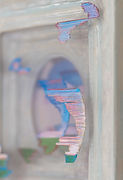
Perceiving this subtraction in the image of empty frames, the artist creates objects in which the frame is used “against its intended function”—that is, outside the codified norms established by painting tradition.
“. . . In her works, Akimova deconstructs not only nature but also culture.
The central line of inquiry in the series Embroidered Landscape is the relationship between Nature and Culture, as well as the place of the human being within these two vast systems.
The interaction of these systems—their role in shaping the human—and their dynamic influence are problematized through the well-known antithesis of nature vs. nurture, the debate on the balance between innate traits and acquired behaviors. . .”
(Yaroslav Volovod)
". . . Art is our cry about the visible. We have forgotten how to simply look without reporting it. We begin to feel as if we do not exist. Or that someone is suffering without our response, which in turn makes us suffer. It is hard for a human being to just look — without correcting or erasing what is seen, without judging it or marking the landscape with their own presence. Even the word 'landscape' imposes an idea and a form of representation onto space.
Emptiness is sacralized in objects where colored thread, instead of pigment, on a transparent base — invisible like a canvas disappearing under paint — evokes painting, yet depicts the disappearance of reality rather than its form; in other words, it represents the materiality of absence itself. These are machines of depletion — of anthropological practices, of art above all. They merge geological, biological, and cultural time into an endless duration of the present without history. . ."
(Aleksandr Evangeli)


.jpg)

.jpg)
.jpg)
.jpg)


.jpg)


